
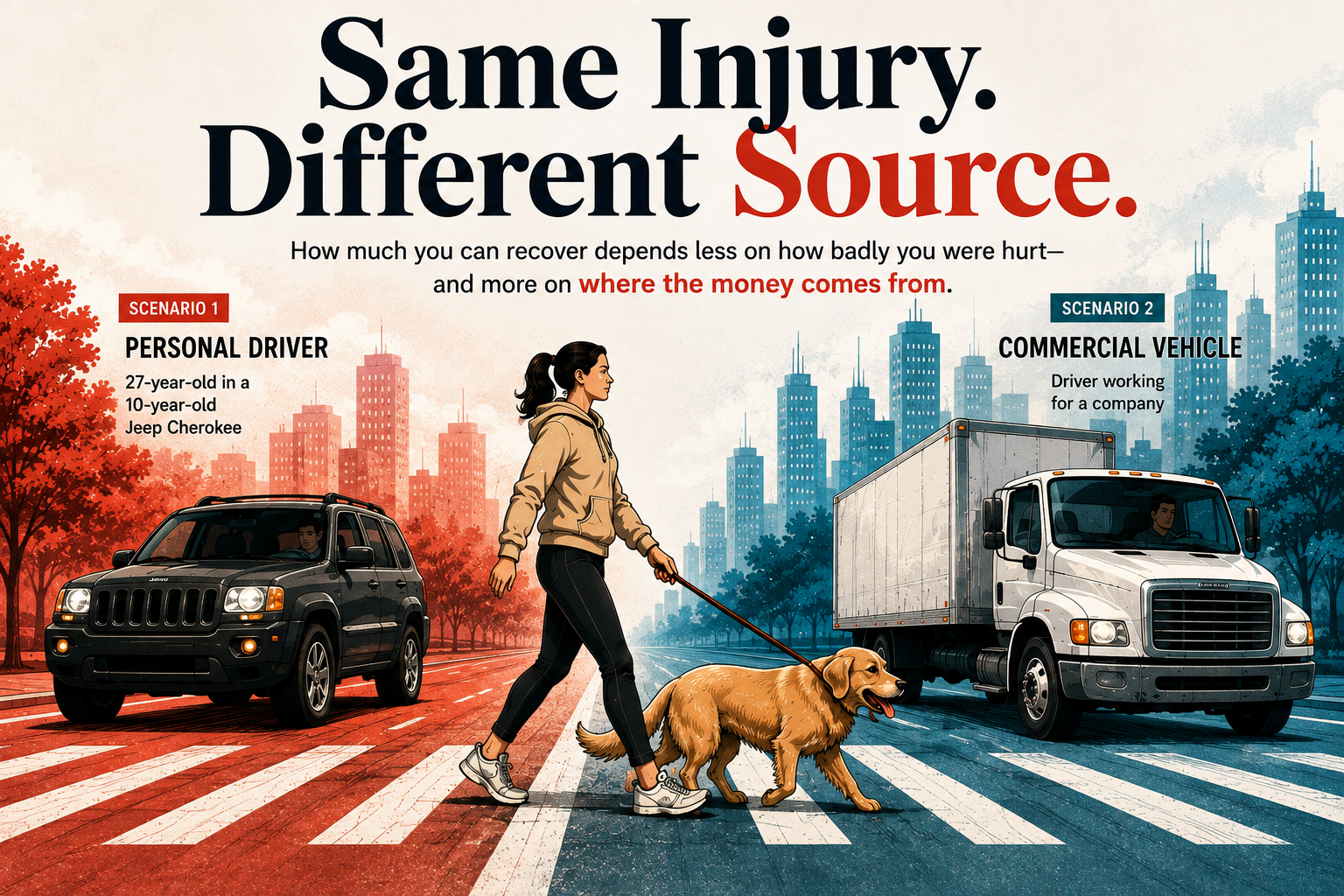
What Is My Injury Case Worth? Why the Same Injury Can Be Worth $30,000 or $1.5 Million
The injury may be identical. The money available to compensate the injured person may be completely different.
A woman recently called our office after being hit by a car while walking her dog across an intersection.
Her ankle was badly broken. She expected multiple surgeries.
Before calling us, she had asked ChatGPT what her case might be worth. She came away expecting more than $1.5 million.
Could an injury like hers result in a million-dollar recovery?
Yes.
Could the same injury result in a recovery of only $30,000?
Also yes.
That sounds strange until you understand something important about injury cases:
The value of the harm and the money available to pay for that harm are not the same thing.
We had barely seen her case. We had some medical bills, but not all of her medical records. We had not seen the driver’s insurance policy. We had not investigated his assets or whether another source of compensation might exist.
What we knew was simple: the driver was a young man in an older SUV.
Her injuries could be extremely serious. Her losses could eventually be very large.
But neither fact, by itself, tells us how much money she can actually recover.
Same Injury. Different Source of Payment.
Imagine the exact same accident.
Same pedestrian.
Same broken ankle.
Same surgeries.
Same pain.
Same impact on her life.
Now change only who caused the accident and what resources are available to pay the claim.
Scenario 1: A Personal Driver
Suppose the driver has only California’s minimum bodily injury liability insurance.
For policies issued or renewed on or after January 1, 2025, California’s minimum is $30,000 for bodily injury or death to one person.
A terrible injury does not turn a $30,000 insurance policy into a $1.5 million policy.
The injured person may have medical bills and losses far greater than $30,000. That does not make the insurance company responsible for paying beyond the coverage its customer purchased.
Of course, insurance is not always the end of the investigation.
A lawyer should look for other possible sources of compensation. The driver may have assets. There may be another responsible party. The injured person may have insurance of her own that applies.
But sometimes, after everything is investigated, there simply is not enough available money to fully compensate the injured person.
That is a difficult reality of some injury cases.
Scenario 2: A Commercial Driver
Now change one fact.
Suppose the same pedestrian suffers the same injury, but this time she is hit by a commercial vehicle driven by someone working for a company.
Her ankle did not suddenly become more broken.
Her surgery did not become more painful.
But the financial picture may be completely different.
There may be commercial auto insurance. The employer or company may also be legally responsible. Other insurance or resources may be available.
The amount available to compensate the injured person can therefore be dramatically different.
Same person. Same injury. Same pain. Different source of payment.
Why You Cannot Value a Case From the Injury Alone
People naturally focus on the injury.
- “I broke my ankle.”
- “I needed surgery.”
- “I cannot work.”
Those facts matter enormously. They help determine the amount of harm suffered.
But there is another question that matters:
Who can legally be required to pay, and what money is actually available?
That is why a responsible lawyer cannot hear “broken ankle” and immediately announce that the case is worth $500,000, $1.5 million, or any other specific number.
There is still too much we do not know.
What About Those Million-Dollar Lawyer Ads?
You have probably seen advertisements like:
“$1.5 MILLION SETTLEMENT”
“$3 MILLION RECOVERED”
Those results may be completely real.
And skilled lawyers can make an enormous difference in the outcome of a case.
But the big number does not tell you the whole story.
There is an important question hiding behind every large settlement:
Where did the money come from?
- Was there a commercial insurance policy?
- Was a company responsible?
- Were several parties responsible?
- Were there multiple insurance policies?
- Were substantial assets available?
Without that information, a settlement number tells you surprisingly little about why the case produced that result.
A good injury lawyer can investigate insurance, identify responsible parties, uncover additional sources of recovery, gather evidence, prove the client’s losses, negotiate with insurers, and take a case to trial when necessary.
Those things matter.
But even an excellent lawyer cannot create an insurance policy that never existed or manufacture assets that a defendant does not have.
Give the same excellent lawyer two clients with equally devastating injuries.
One was injured by a well-insured commercial defendant.
The other was injured by an individual with a small insurance policy and no realistic source for collecting substantially more.
Their recoveries may be dramatically different.
The lawyer did not suddenly become less skilled. The available source of payment changed.
Winning a Case and Collecting Money Are Different Things
This distinction also explains another common misunderstanding.
A jury might decide that an injured person suffered $1 million in damages.
That does not necessarily mean a $1 million check arrives in the mail.
A judgment tells us what the defendant legally owes.
Collecting that judgment is a separate question.
If sufficient insurance or assets exist, collection may be possible.
If they do not, winning a large judgment can be very different from actually receiving that amount.
That is why experienced injury lawyers investigate not only what happened and how badly someone was hurt, but also where a recovery could realistically come from.
So What Is Your Injury Case Worth?
There is no responsible answer based only on the name of the injury.
Before putting a dollar figure on a case, we need to answer at least three basic questions:
- How badly were you hurt?
- Who is legally responsible?
- What sources of compensation are actually available?
ChatGPT can explain how injury cases generally work.
An online settlement calculator can produce a number.
A lawyer’s advertisement can show you a giant settlement.
But none of those things, standing alone, can tell you what your case will actually recover.
A serious injury can create a serious claim. It does not create the money to pay it.
This article is general information about how injury claims work. It is not legal advice, and reading it does not create an attorney-client relationship. Every injury case is different. Past results do not guarantee a similar result.